
Australian environmental markets
On this page
- ACCU and Safeguard Mechanism credit unit (SMC) market dynamics summary
- Record first half ACCU issuance
- Project registrations
- ACCU Scheme methodology and policy updates
- ACCU holdings grow, SMC holdings stable
- Cost containment measure and permanent exit arrangement outcomes
- Scheduled Safeguard Mechanism review underway
- Non-safeguard cancellations
- Generic ACCU and SMC spot prices stable
- Other market developments
ACCU and Safeguard Mechanism credit unit (SMC) market dynamics summary
| ACCU | Supply | Demand |
|---|---|---|
| Balance carried forward from Q1 2026 | 56.5 m | - |
| ACCU supply | +5.4 m | - |
| ACCU Scheme contract deliveries* | - | -0.4 m |
| Safeguard surrenders | - | 0 m |
| Non-safeguard cancellations | - | -0.3 m |
| Net balance at the end of Q2 2026 | 61.2 m | |
| Cost containment measure balance at end of Q1 2026 | 5.6 m | |
| Quarterly change in cost containment measure* | +0.4 m | |
| Cost containment measure balance at the end of Q2 2026 | 6.0 m | |
Notes:
- Totals may not sum due to rounding.
- *This refers to ACCUs delivered under Commonwealth carbon abatement contracts in the quarter. These ACCUs are held in the cost containment measure and are available to eligible safeguard entities to purchase at a fixed price of $87.72 for 2026–27, rising at the Consumer Price Index plus 2% each year.
| SMC | Supply | Demand |
|---|---|---|
| Balance carried forward from Q1 2026 | 11 m | - |
| SMC supply | <0.1 m* | - |
| Safeguard surrenders | - | 0 m |
| Net balance at the end of Q2 2026 | 11.0 m | |
Note: *SMC issuances generally occur around 31 January following the end of the relevant reporting period. However, there is no legislative deadline to apply for SMCs so issuances can occur throughout the year and across compliance years depending on when we receive the application.
Record first half ACCU issuance
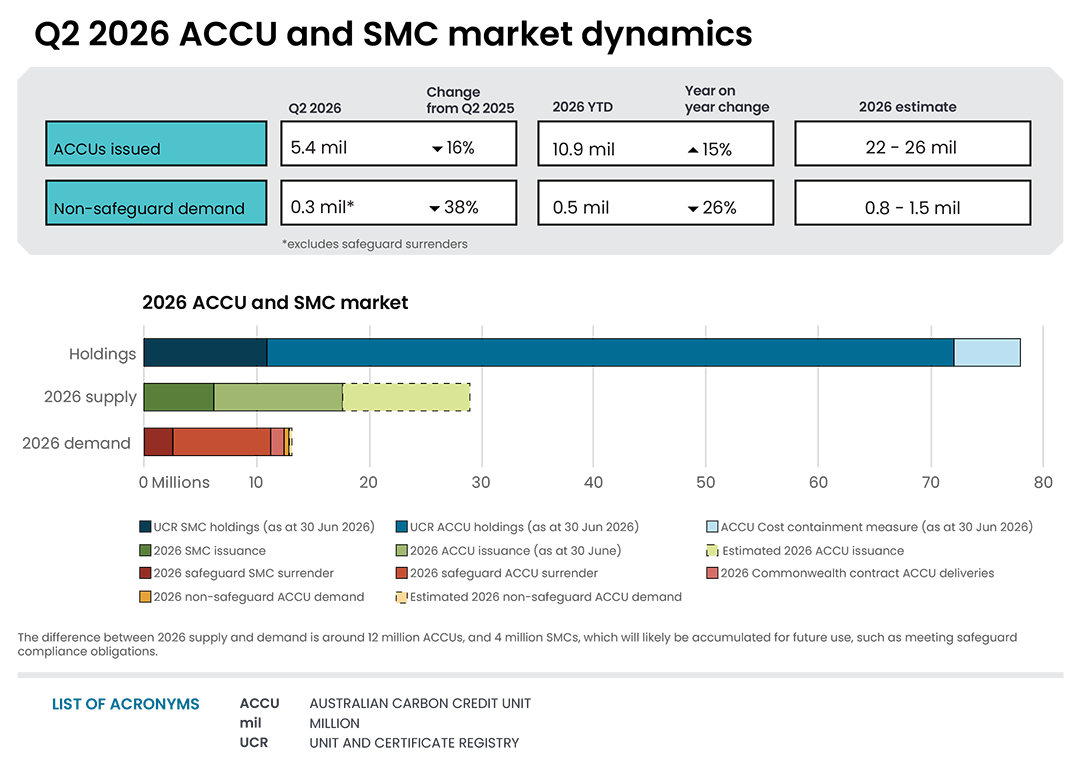
In Q2 2026, 5.4 million ACCUs were issued, 16% lower than the 6.5 million in the same period last year. The quarterly result was driven by 2.7 million ACCUs issued to vegetation projects and 1.5 million ACCUs issued to waste projects. It includes a record 0.4 million ACCUs issued to agriculture projects which include animal effluent management, soil carbon sequestration, and beef cattle herd management methods.
This brings total year to date issuance for 2026 to 10.9 million ACCUs, a record for the first half of the year and on track to meet our estimated range of 22 to 26 million for the year.
Looking ahead, one contributor to issuance in the second half of 2026 will be credits issued to avoided deforestation projects for abatement resulting from eligible growth in biomass over the projects’ crediting periods. Biomass and carbon stores increase as the forest is allowed to mature, supported by active project management including managing risk of fire, drought and other disturbance events. Under the avoided deforestation method, for forest growth to be credited, there are strict requirements for biomass surveys to be conducted to determine the change in carbon stocks during the crediting period of the project. This provides an opportunity for participants to earn credits where they can substantiate increased carbon in the carbon pool through in-field measurements where eligible forest growth has occurred. As of 24 August 2026, this has resulted in an additional issuance of 0.3 million ACCUs to 2 projects. This represents an average 20% increase in carbon stock. While this increase may appear significant, it represents biomass enhancement achieved over the full 15-year crediting period.
Description
This figure shows ACCUs issued by method type quarterly over time. This includes ACCUs that have been relinquished.
Small print
ACCU issuance follows a seasonal pattern for certain method types, including industrial fugitive and savanna fire management. Other includes energy efficiency, industrial fugitives, agriculture, carbon capture, transport and facilities method types.
Project registrations
In Q2 2026, 75 ACCU Scheme projects were registered, lower than the 98 in the same period last year. Soil carbon project registrations are the lowest since the 17 in Q3 2023; participants have likely been awaiting the outcome of ERAC’s recent periodic review of the soil carbon 2021 method which was released in July and is discussed further below.
Looking forward, registrations under the plantation forestry method are expected to decrease following the November 2025 closure of grant applications for the final funding round of the Department of Agriculture, Fisheries and Forestry’s (DAFF’s) Support Plantation Establishment program. This grant supports the creation of new projects. Project registration under DAFF’s program will continue through to the end of 2026–27, with the decrease in related ACCU Scheme registrations expected to become more evident after that point.
ACCU Scheme methodology and policy updates
ACCU Scheme methodologies continue to be developed and periodically reviewed to ensure the methods remain compliant with the Offsets Integrity Standards (the standards).
In April 2026, ERAC concluded its periodic review of the soil organic carbon method 2021, concluding that the method currently complies with 5 of the 6 standards. After reviewing initial results from some projects, ERAC concluded the method needs to be strengthened to meet the ‘Conservative’ standard. This was because reported soil organic carbon accrual rates from some projects exceeded that supported by peer-reviewed scientific literature.
To address this issue the department undertook public consultation on a proposal to amend the method’s Supplement to cap crediting, with the effect that projects with a 25-year permanence period can only receive credits for soil organic carbon accruals up to 3 tonnes of carbon per hectare per year (3 tC/ha/yr) after permanence and risk of reversal discounts. Projects with 100-year permanence periods are not subject to the 20% permanence discount and therefore the calculations result in a higher crediting cap of 3.8 tC/ha/yr. Seven projects currently have 100-year permanence periods.
The department’s consultation ran from 28 July to 18 August 2026. The department is currently considering the feedback received and next steps associated with the method’s proposed updates.
This cap is expected to affect a small minority of soil carbon projects in the early years or where sampling and stratification is limited. Understanding the proposed cap on credited abatement in the soil carbon method explains the operation of the cap using 3 hypothetical projects.
Taking a broader view, the periodic review process shows the strength of the ACCU Scheme architecture for delivering high-integrity abatement, with independent expert review, regulatory oversight, and ongoing monitoring of project performance working together to support method integrity. The periodic review of methods enables them to be refined and improved over time as developments in scientific evidence, improved estimation techniques and technological advances become available, helping to maintain the integrity of credited abatement.
Development of the proposed integrated farm and land management (IFLM) method continues, with a draft final method to be submitted to ERAC by the end of the year for assessment against the legislated standards. In response to the periodic review of the soil organic carbon method 2021, the department will not include a soil carbon activity module in the first version of the IFLM method but will prioritise the soil carbon module after the delivery of the first version of the method.
The improved native forest management (INFM) method was approved by the Australian Government on 25 June 2026. The INFM method allows eligible state governments to generate ACCUs by reducing or ceasing planned wood harvesting in multiple-use public native forests. The Senate is expected to vote on a disallowance motion on the method on 15 September 2026.
The avoided re-clearing and native reforestation (ARNR) method is progressing. This proponent-led method is being developed by the Queensland Government with the intention of replacing and improving the expired avoided clearing of native regrowth method. The method would allow ACCUs to be generated through retention of native regrowth vegetation that is at risk of future clearing and through native reforestation activities on eligible land.
More information on these and other methods can be found on the department’s ACCU method tracker.
Proposed legislative amendments to the Carbon Credits (Carbon Farming Initiative) Act 2011 to deliver on a range of recommendations from previous reviews of the ACCU Scheme were introduced to Parliament on 20 August 2026. For more information, see the explanatory memoranda on the Parliament of Australia’s website.
Representation of soil sequestration cap on 3 illustrative projects with sampling every 5 years
Note: This figure is not interactive.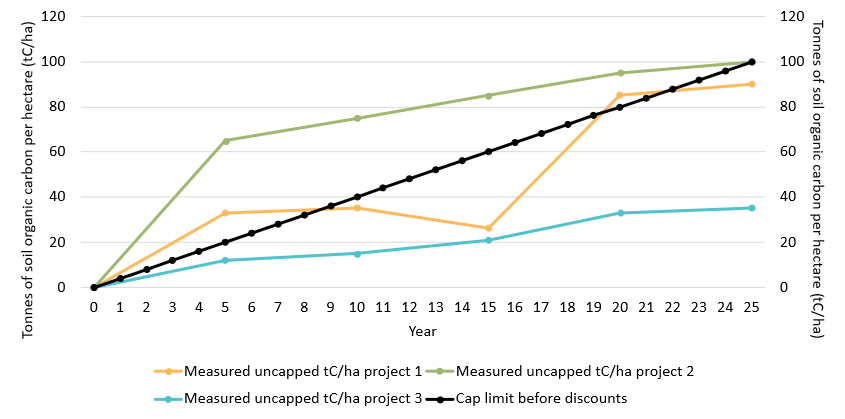
Description
This figure shows 3 illustrative projects and their measured tC/ha in relation to the proposed cap from the Emissions Reduction Assurance Committee's period review.
Small print
In situations where a project has unmeasured accrual above the cap limit, ACCUs are only ever issued to the maximum sequestration value of the cap limit after discounts. This figure shows increases in soil carbon before discounts for emissions, permanence, and the risk of reversal buffer. The issuance cap of 3 tC/ha/yr for 25-year projects is achieved through a cap of 4 tC/ha/yr before these discounts. The data presented is fictional and for illustrative and explanatory purposes. It does not represent, reflect, or relate to any actual data, or projects.
Description
This figure shows registered projects under the ACCU Scheme by method type quarterly over time.
Small print
The 'agriculture' method type has been segregated into 'agriculture - soil carbon' and 'agriculture - other' to highlight growth in the soil carbon sector. The 'agriculture - soil carbon' method includes the ‘measurement of soil carbon sequestration in agricultural systems' method, the ‘sequestering carbon in soils in grazing systems’ method and the 'estimation of soil carbon sequestration using measurement and models' method.
Other includes energy efficiency, agriculture - other, savanna fire management, transport, industrial fugitives, facilities and carbon capture method types.
Revoked projects are excluded. Historical data may change due to project revocations.
For more detail on registered projects, refer to the project register.
ACCU holdings grow, SMC holdings stable
At the end of Q2 2026, ACCU holdings, excluding the cost containment measure, rebounded to 61.2 million. This growth is expected and followed ACCU holdings dipping to 56.5 million at the end of Q1 2026 after the surrenders for the 2024–25 safeguard compliance period.
Safeguard holdings had the largest increase of 3.9 million while ACCU project proponent and business holdings decreased by lesser amounts. After an increase of 4.2 million, safeguard and safeguard-related accounts held 68% of ACCUs at the end of Q2 2026.
Description
This figure shows ACCU holdings in Unit and Certificate Registry (UCR) accounts as of 30 June 2026 by market participation and the cost containment measure quarterly over time.
Small print
Totals may not sum due to rounding. ACCU holdings data excludes ACCUs held in accounts controlled by the Australian Government for scheme administration purposes. Historical values may change retrospectively due to changes in the classification of UCR accounts as new information becomes available. UCR accounts are categorised based on their main activity, as some accounts may fulfill conditions for multiple categories.
Holdings have not been categorised prior to 2019 as the categories cannot be mapped.
Category definitions
ACCU project proponent
An account holder is connected to one or more ACCU Scheme projects. The connection to projects has been determined based on the available project information. Entities may have linkages to projects that have not been disclosed to the Clean Energy Regulator.
Safeguard
Account holders are safeguard entities that control a single account, or in cases where safeguard entities control multiple accounts, only those that have surrendered ACCUs for safeguard compliance purposes or have specified a facility are included. Some safeguard accounts also engage in trading activity, which may result in holding fluctuations in this category.
Safeguard related
Account holders are companies, such as subsidiaries, that are related to registered safeguard entities. These accounts do not specify a facility or have not surrendered ACCUs for safeguard compliance purposes. These ACCU holdings may be used for future safeguard compliance purposes.
Intermediary
An account holder’s primary operation is to facilitate the trading of ACCUs between the supply and demand sides of the market. This also includes accounts that have accumulated ACCUs through the secondary market without known compliance obligations, offset use, or carbon trading/offset services.
Government
Account holders are government entities that are accumulating for voluntary or compliance purposes.
Business
Account holders do not have a direct link to ACCU Scheme projects. Account holders include participants that are accumulating for voluntary purposes.
Total holdings
For the ACCU scheme, total holdings in the Unit and Certificate Registry are the sum of ACCUs held in ACCU project proponent, safeguard, safeguard related, intermediary, government, and business accounts and exclude accounts controlled by the Clean Energy Regulator such as the cost containment measure.
Cost containment measure
ACCUs that have been delivered under Commonwealth carbon abatement contract milestones after 12 January 2023. These ACCUs will be available to eligible safeguard entities under the cost containment mechanism. This is not included in total holdings.
As expected, SMC holdings remained stable at 11 million, with only a single small issuance in Q2 2026. SMC issuances typically occur during Q1 of each year. Holdings in safeguard accounts increased by 0.1 million while intermediary holdings fell by the same amount. At the end of Q2 2026, safeguard and safeguard-related accounts held 96.8% of SMCs in the UCR, with the remainder being held by intermediary accounts.
Description
This figure shows SMC holdings in Unit and Certificate Registry (UCR) accounts by market participation quarterly over time.
Small print
Totals may not sum due to rounding. Historical values may change retrospectively due to changes in the classification of UCR accounts as new information becomes available. UCR accounts are categorised based on their main activity, as some accounts may fulfill conditions for multiple categories.
Category definitions
Safeguard
Account holders are safeguard entities that control a single account, or in cases where safeguard entities control multiple accounts, only those that have surrendered SMCs for safeguard compliance purposes or have specified a facility are included. Some safeguard accounts also engage in trading activity, which may result in holding fluctuations over time.
Intermediary
An account holder’s primary operation is to facilitate the trading of SMCs between the supply and demand sides of the market. This also includes accounts that have accumulated SMCs through the secondary market without known compliance obligations.
Safeguard related
Account holders are companies, such as subsidiaries, that are related to registered safeguard entities. These accounts do not specify a facility or have not surrendered SMCs for safeguard compliance purposes. These SMC holdings may be used for future safeguard compliance purposes.
ACCU project proponent
An account holder is connected to one or more ACCU Scheme projects. The connection to projects has been determined based on the available ACCU Scheme project information. Entities may have linkages to ACCU Scheme projects that have not been disclosed to the Clean Energy Regulator.
Cost containment measure and permanent exit arrangement outcomes
In Q2 2026, 0.4 million ACCUs were delivered against carbon abatement contracts. This brings the total held in the cost containment measure to 6.0 million.
The permanent exit arrangement for fixed delivery carbon abatement contracts opened on 1 July. These allow eligible sellers to apply to fulfil their contractual obligations by receiving a 60% discount on their exit payment, after they deliver at least 25% of the outstanding volume of ACCUs (as of 1 January 2025).
This discount acknowledges that market and policy settings have changed since the introduction of carbon abatement auctions and fixed delivery contracts in 2015. Prior to the Safeguard Mechanism reforms, the Australian Government was the main purchaser of ACCUs through carbon abatement contracts. The market is now well established, and the primary source of demand is now safeguard compliance.
On 25 August, we published the July carbon abatement contract register, showing 1.6 million ACCUs have been delivered from fixed delivery contracts since 1 January 2025. This provides the visibility of progress against the delivery threshold required to access the discounted exit payment arrangements.
While the arrangements run to 2030, we are beginning to see some sellers look to make delivery and then exit in quick succession rather than spread the obligation throughout the period. Delivery and exit decisions will vary across contract holders and reflect a range of project, market and financial drivers. While many sellers are choosing to finalise their contractual obligations quickly, others’ schedules may be more closely linked to project performance, ACCU availability and broader commercial considerations, resulting in deliveries spread over longer timeframes and concentrated at points rather than spread evenly over the period. According to our new six-monthly projections, we expect at least 0.6 million ACCUs to be delivered and 91 contract exits under the arrangements over the period to December 2026.
New regular projections of expected deliveries
We are publishing six-monthly projections of expected ACCU deliveries and exits under fixed delivery carbon abatement contracts to support market transparency. These projections represent the minimum volume of ACCUs expected to be delivered or exited over the following 6 months based on contractual commitments received at the time of publication. Actual volumes may be higher where sellers deliver ACCUs or submit exit applications ahead of schedule.
The first six-monthly projection was published on 25 August 2026. Projections will be updated in February and August each year, covering the first and second half of the calendar year respectively. These projections will be accompanied by actual delivery and exit outcomes for the previous six-monthly projection period. This provides a continuing view of how contractual obligations are being fulfilled through ACCU deliveries and the permanent exit arrangement through to 2030.
Additional information on the contract register
The volume of ACCUs released under exit arrangements is published on the carbon abatement contract register to support transparency and inform market decisions. To further support this market transparency, the contract register will provide the following information for each contract from August 2026:
- outstanding contract volume as of 1 January 2025 – shows the baseline volume of ACCUs remaining under fixed delivery contracts
- ACCUs delivered since 1 January 2025 – shows progress towards eligibility for discounted exit payments
- ACCUs exited since 1 July 2026 – shows the volume of contractual obligations met through the permanent exit arrangement rather than through ACCU deliveries.
While we are committed to supporting market transparency, there are limits to the information we can publish about the circumstances or decisions of individual contract holders. Carbon abatement contracts are commercial arrangements, and participation in the permanent exit arrangement is voluntary. The additional information published on the contract register is intended to provide greater insight into ACCU supply and demand dynamics across the market while balancing commercial sensitivities.
As this information is provided for all eligible fixed delivery contracts, it should not be used to infer whether a particular seller has entered, or intends to use, the permanent exit arrangement. Delivery schedules, exit outcomes and contract performance vary across contract holders, reflecting individual commercial circumstances and agreements negotiated with the Clean Energy Regulator on behalf of the Commonwealth. Consistent with our contract management principles, we may agree to revised delivery schedules if the seller doesn’t have sufficient ACCUs available to meet their delivery obligations.
Where ACCU deliveries or exits are not shown against a particular contract, this may reflect a range of factors, including agreed delivery schedules, project development timelines, or the availability of ACCUs. For example, some projects may not yet have begun reporting and claiming ACCUs. Where a seller is unable to meet its delivery obligations, we may enter good faith negotiations to revise delivery schedules, consistent with our contract management principles. In some cases, these negotiations may be ongoing, and a revised delivery schedule has not yet been finalised. Learn more about the permanent exit arrangement.
Scheduled Safeguard Mechanism review underway
Consultation on the 2026–27 Safeguard Mechanism review has commenced. Following the 2023 reforms, a review of the Safeguard Mechanism was scheduled for 2026–27 to ensure the reformed scheme settings remain appropriately calibrated and continue to deliver emissions reductions in line with Australia’s targets. The review is not intended to make fundamental reforms to the design of the policy. It will consider a range of Safeguard Mechanism settings including:
- the 2030–2035 decline rate for baselines. See our safeguard baselines webpage for guidance on how baselines are calculated.
- scheme coverage arrangements, considering any competitiveness issues, abatement potential and regulatory compliance
- the future role of SMCs, ACCUs and international units
- whether the scheme is appropriately incentivising onsite abatement
- the suitability of arrangements for trade-exposed facilities
- consideration of the recommendations of the Carbon Leakage Review.
The Climate Change Authority released a consultation paper on 2 July with a focus on the Safeguard Mechanism’s contribution to the national target and on-site abatement. It will provide advice to Government as part of its Annual Progress Report.
The department released its Safeguard Mechanism review consultation paper on 7 August 2026 with written submissions closing on 18 September 2026. The paper includes the Government’s principles to guide the review, which reflect the review’s focus on policy stability. See the department’s consultation hub for further information.
The Australian Government intends to release a position paper containing final positions early next year. Without precluding earlier resolution of implementation issues raised in consultation, any changes to the Safeguard Mechanism will generally take effect from 1 July 2030.
Non-safeguard cancellations
In Q2 2026, 0.3 million ACCUs were cancelled for non-safeguard purposes, 0.2 million lower than the same period last year. As discussed in previous QCMRs, non-safeguard cancellations have been on a downward trend since 2023. Non-safeguard cancellations are on track to meet our estimated range of 0.8 to 1.5 million.
Description
This figure shows ACCU non-safeguard (voluntary, compliance, and government) cancellations quarterly over time.
Small print
ACCU cancellations exclude deliveries against Commonwealth carbon abatement contract milestones, surrenders for safeguard purposes, and transfers to the Commonwealth Regulatory Additionality Holding Account. This classification system is uniform across ACCU and large-scale generation certificate (LGC) cancellations. Historical values may change retrospectively due to changes in the classification as new information becomes available.
Category definitions
Voluntary
Cancellations made against voluntary certification programs and any sort of organisational emissions targets.
Compliance
Cancellations made by private organisations and corporations for compliance or obligations against municipal, local, state and territory government laws, approvals, or contracts. For example, cancellations to meet Environmental Protection Authority requirements.
Government
Cancellations by or on behalf of government entities. For example to offset emissions from vehicle fleets or meet voluntary emissions reduction targets.
Generic ACCU and SMC spot prices stable
The generic volume-weighted ACCU spot price rose from $36.28 at the end of Q1 2026 to $37.95 at the end of Q2 2026. The ACCU spot price rose after Q2 reaching $39.03 on 14 August 2026.
SMC spot prices have continued to follow ACCU prices closely, reaching $38.00 on 19 June 2026. Reported SMC trading slowed down in Q2 2026 in line with the safeguard compliance period having concluded, with less than half of the traded volume in Q1 2026. Following the end of the quarter, SMC spot prices continued to follow ACCU prices closely, reaching $39.25 on 14 August 2026.
Generic Australian carbon credit unit (ACCU) and Safeguard Mechanism credit unit (SMC) volume weighted average spot price
Note: This figure is not interactive.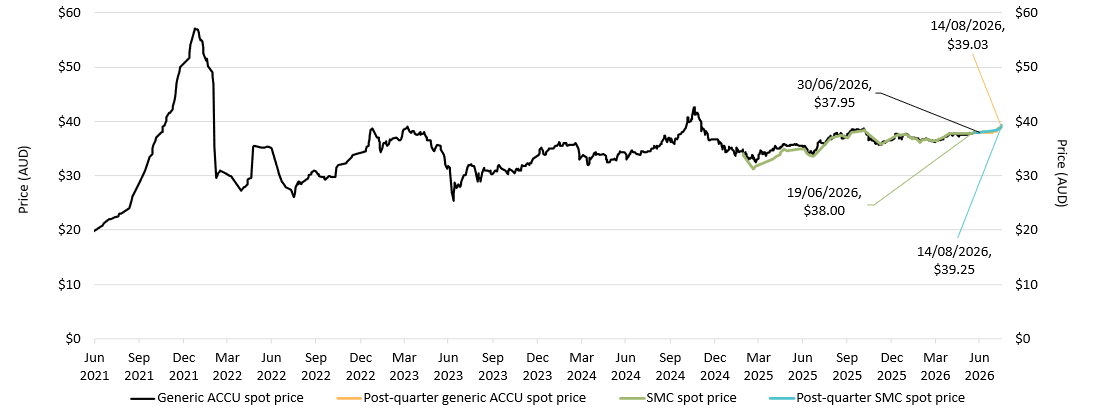
Description
This figure shows the volume weighted average of the generic ACCU and SMC spot prices over time.
Small print
The generic spot price refers to the daily volume weighted average price of spot trades for ACCUs with an unspecified method and spot trades for SMCs. Spot trade data is compiled from trades reported by Jarden and CORE markets, and may not be comprehensive. Prices are shown from 30 June 2021 to 14 August 2026. The last quarterly reported daily volume weighted average spot prices for generic ACCUs and SMCs are labelled.
Other market developments
Second Nature Repair Market project registered
Project registration and method development continues in the Nature Repair Market.
In Q2 2026, a second Nature Repair Market project was successfully registered under the replanting native forest and woodland ecosystems 2025 method. This project is ‘stacked’ with a reforestation by environmental or mallee plantings Full Carbon Accounting Model 2024 method ACCU Scheme project, meaning that the project proponent is allowed to participate in both ACCU Scheme and Nature Repair Market on the same area of land, generating ACCUs and a biodiversity certificate. This approach recognises the additional activities beyond the ACCU method requirements to support biodiversity benefits being delivered in the Nature Repair Market as required by the method. To ensure additionality, there are limitations on stacking Nature Repair Market projects where environmental offsets are involved with ACCU Scheme projects on the same area of land.
Between 1 July and 29 July 2026, the department conducted a public consultation on the draft Enhancing Native Vegetation (ENV) method. This method would support projects in Australia's productive and historically cleared areas. Under the ENV method, projects could:
- enhance the condition of remnant vegetation
- maintain the condition of moderate to high condition remnant vegetation
- revegetate areas without remnant vegetation through environmental planting and/or facilitated regeneration.
Reforms to national environmental laws in November 2025 allow for biodiversity certificates under the Nature Repair Market to be used as environmental offsets if specified under methods. The ENV method will be the first ‘offset-capable’ method under the Nature Repair Market and is expected to be legislated in late 2026. Information on the new environmental laws is available on the department’s website.
First Product Guarantee of Origin person registered
The Product Guarantee of Origin registered its first person, Hiringa Sundown (GEGHA) Project Co Pty Ltd. They are establishing the Good Earth Green Hydrogen and Ammonia (GEGHA) facility in Moree, New South Wales, and are expecting to start producing hydrogen in early 2027.
Emissions accounting methods for hydrogen by gas reforming, gasification and pyrolysis, biogas and biomethane, iron ore and aluminium, along with associated cost recovery arrangements, are expected to be made in the coming months.
Data sharing trial to connect CER and environmental registries
We have started a data-sharing trial with Accounting for Nature and Eco-Markets Australia. The trial, which commenced in August 2026, is open to ‘third-party’ registries housing certificates or credits that either relate to or derive value from our units and certificates. Accounting for Nature and Eco-Markets Australia issue nature-based certificates and credits, respectively, linked to ACCUs.
The trial follows our Registry Interoperability Project and is part of our commitment to implementing interoperability where feasible and consistent with our draft interoperability principles. This data exchange trial enables participating third-party certificate or credit registries to view specified ACCU holdings, subject to account holder consent and agreed governance arrangements. By improving interconnectivity between registries, the trial aims to reduce administrative burden, improve transparency and streamline market participation to support deep, liquid, and enduring carbon and environmental markets.