
We issue biodiversity certificates to eligible projects under the Nature Repair Market scheme.
You can earn a biodiversity certificate for delivering verified improvements to or protection of Australian biodiversity, known as the biodiversity outcome for a project. To apply for a certificate, you must have a registered biodiversity project and meet the thresholds for certificate issuance set out in a relevant method.
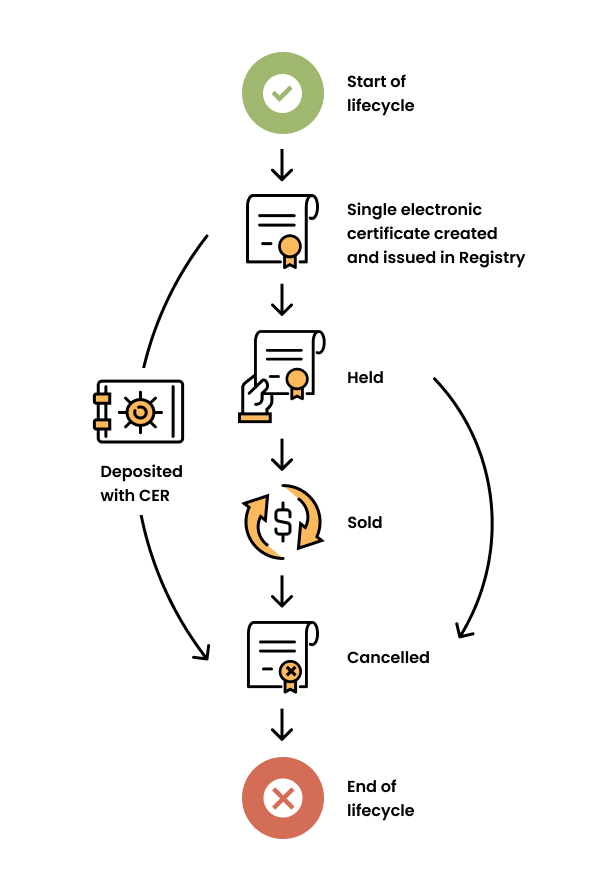
Certificates are tradable and can be held, sold to private buyers or deposited with the Clean Energy Regulator. Through this market mechanism, the scheme incentivises actions to restore and protect the environment.
Information on the Biodiversity Market Register will allow buyers to understand and value the biodiversity outcome associated with a project.
Participation in the Nature Repair Market is voluntary.
About biodiversity certificates
Biodiversity certificates represent the biodiversity outcome delivered by a project. We can issue one digital certificate per project.
If project registration is conditional on obtaining regulatory approvals or relevant consents, you must provide these before we can issue a biodiversity certificate for your project.
Once your certificate is issued in the Unit and Certificate Registry, you can choose to:
hold onto your certificate
deposit your biodiversity certificate with us to show an ongoing commitment to a project
sell your certificate to an individual or business looking to invest in nature.
At the end of the project's permanence period, the certificate is cancelled.
Certificate lifecycle
Applying for a certificate
You can apply for a biodiversity certificate once your project has progressed enough to achieve, or is likely to achieve, the biodiversity outcome and the required ecosystem condition thresholds. If you’ve nominated a culturally significant entity, its thresholds must also be met.
If you use Indigenous knowledge and values in project design or implementation, you must demonstrate that you have done so in line with the consent of the relevant Indigenous representatives, when applying for a biodiversity certificate.
If we approve your application, we will issue you a biodiversity certificate for your project.
Buying and selling certificates
Owning a biodiversity certificate may have financial implications. We recommend you seek independent advice on the implications and responsibilities of owning or trading a biodiversity certificate.
Buyers and sellers can transfer ownership of certificates through the Unit and Certificate Registry.
The Department of Climate Change, Energy, the Environment and Water has also published an example contract to help parties agree to terms relating to investing in projects or certificates.
Relinquishing certificates
You must relinquish your biodiversity certificate if:
- you cancel your project, which requires a voluntary relinquishment
- we issue a relinquishment notice.
Relinquishment notices may be issued if you don’t maintain the biodiversity outcome in the project area for the duration of the permanence period. This includes if the biodiversity outcome is reversed on the basis of false or misleading information, or where natural disturbance causes a significant reversal which is not remedied.
There are 2 options to comply with a relinquishment notice. You can either:
- give back the original biodiversity certificate that the notice relates to
- if you have sold the biodiversity certificate or it’s been cancelled, purchase an equivalent certificate (or certificates) and then relinquish those certificates.
Biodiversity maintenance declarations
We may issue a biodiversity maintenance declaration if you don’t comply with the above relinquishment notices. This is generally used as a last resort and occurs when there has been non-compliance or likely non-compliance.
Biodiversity maintenance declarations prohibit one or more activities in relation to the biodiversity maintenance area. This helps protect remaining biodiversity and prevent further losses. For example, under the replanting method, a declaration could prevent a proponent or any other person from conducting activities that involve the destruction of native plants in the project area.
These declarations are included in a registered biodiversity project's details on the Biodiversity Market Register.
Biodiversity Market Register
The Unit and Certificate Registry is different from the Biodiversity Market Register. The registry is where you can undertake transactions. The register is the source of truth for information about projects and any project certificates.
On the Biodiversity Market Register, you can:
- view project details
- learn about their biodiversity outcome
- read about the progress to the biodiversity outcome that led to the issuance of a certificate (if successful).
Claims on biodiversity outcomes
Businesses must comply with the obligations under Australian Consumer Law when making environmental and sustainability claims. These claims must be true and accurate and not likely to give buyers the wrong impression.
Market development
We are working to establish a strong market foundation underpinned by integrity and transparency. The Australian carbon credit units (ACCU) market suggests a strong market foundation will encourage participation from a wide range of sectors. We expect market operation and the Nature Repair Market to evolve over time.
Market supply
Certificate supply will come from registered projects that have been issued a certificate under the Nature Repair Market scheme.
The replanting native forests and woodland ecosystems method is the first Nature Repair Market scheme method. Over time, the Australian Government will develop more methods to support a range of biodiversity projects. These will be informed by collaboration and consultation with experts and stakeholders. See the department’s methods for more information.
Market demand
Sources of demand for biodiversity projects could include:
- investment driven by reporting and disclosure requirements, such as the Taskforce on Nature-related Financial Disclosures
- philanthropic, environmental, social and corporate governance-motivated investment
- carbon market participants seeking projects that also benefit nature.
There is a global trend for businesses to invest in nature-related projects that deliver environmental benefits. The Nature Repair Market supports this by providing opportunities for nature repair through high-integrity projects with lasting impact.
Nature plus carbon
Project proponents may increase their earning potential by stacking a Nature Repair Market scheme project with a related ACCU Scheme project. Stacking means undertaking a biodiversity and carbon project on the same area of land. This means you could earn a biodiversity certificate and ACCUs for activities that are designed to achieve multiple benefits.
You will need to undertake early planning to design the projects to meet requirements of both schemes and the applicable methods. Make sure you’re familiar with the eligibility requirements for both schemes, including the timing of your project activities.
Project proponents can also request to publish additional information on the Biodiversity Market Register. This includes an overlap between the project area of a biodiversity project and the project area of an ACCU Scheme project.