What is the Product Guarantee of Origin?
The Product Guarantee of Origin (PGO) is part of the Guarantee of Origin Scheme. The PGO shows where a product has come from, how it was made, and its emission intensity throughout its life cycle.
Under the PGO, producers, exporters and consumers can use digital certificates to prove where a product was made and the associated emissions from its:
- production, including upstream emissions
- transport
- storage.
This allows Australian producers to make confident, objective and credible claims about the products they make.
How to participate in the PGO
Find out the steps you need to take to participate in the PGO.
PGO certificates
Why participate?
The PGO allows producers to:
- prove emissions intensity claims
- sell GO verified low emissions fuels (hydrogen and methane) to National Greenhouse and Energy Reporting (NGER) Scheme reporters, enabling them to reduce scope 1 emissions for reporting
- access government incentives (like the Hydrogen Headstart program and the Hydrogen Production Tax Incentive)
- differentiate their products in competitive markets, including accessing overseas markets with:
- carbon border adjustment mechanisms
- low-emissions product import requirements
- access state and territory schemes (for example, the NSW Renewable Fuel Scheme).
It allows consumers to:
- demonstrate claims about their use of low emissions intensity products (for example, from 2025–26, NGER Scheme reporters can claim renewable gas use through PGO certificates)
- trust that emissions intensity claims are backed by government-verified data
- make informed choices based on verified emissions information
- demonstrate traceability of scope 3 supply chain emissions.
Stay up to date
Sign up to get the latest updates about the PGO.

How it works
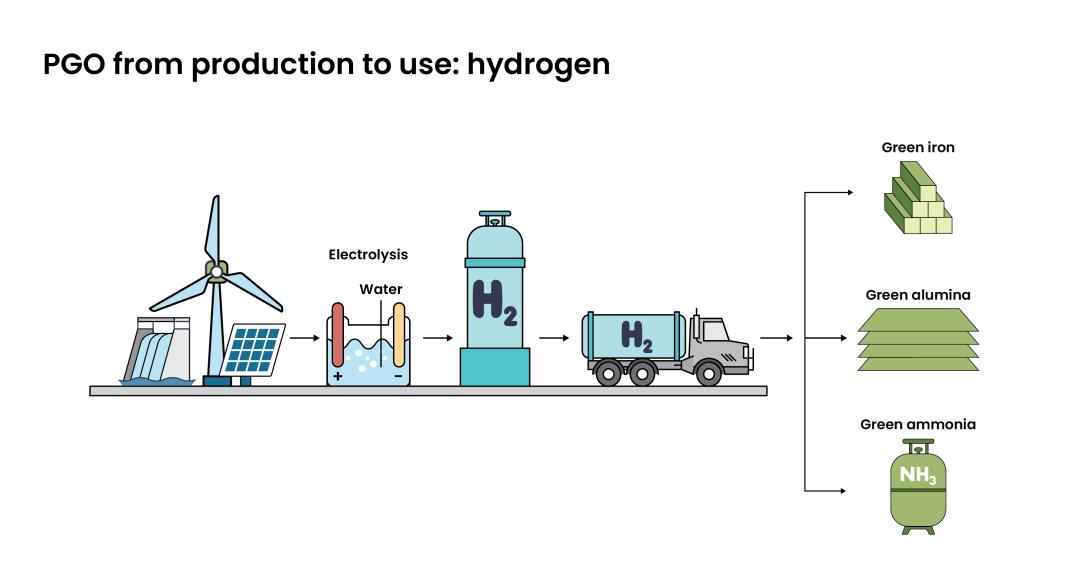
PGO certificates can be created by registered producers for eligible products. As the product moves through the supply chain, extra information is added to the certificate. Certificate information includes:
- production: where and how the product is made, including its emissions intensity at the point of production
- delivery: how the product is transported and stored (e.g. pipeline, truck, ship), including its emissions intensity with post-production emissions included
- consumption: where and how the product is used or exported (e.g. hydrogen used by an ammonia manufacturer).
Certificates also include information specific to a product batch, like the purity and the emissions intensity of the product as it moves along the supply chain. Emissions associated with consumption are not included on PGO certificates.
Certificates are published on the GO Register so consumers can compare how products were made and handled.
Who can participate
Australian businesses can register and apply to certify products made using specific production pathways.
The scheme is currently open to businesses involved in the production, transport and consumption of:
- hydrogen
- biomethane
- biogas
- aluminium
- iron ore.
In future, the government intends to expand the scheme to include other products, such as:
- low-carbon liquid fuels
- other green metals (iron, steel, alumina)
- ammonia.
Our role
We administer the PGO by:
- assessing and approving registered person and profile applications
- registering PGO certificates
- ensuring scheme compliance.
The Department of Climate Change, Energy, the Environment and Water oversees the policy of the GO Scheme. Visit the department’s website for more information about the GO Scheme.
Legislative framework
- Future Made in Australia (Guarantee of Origin) Act 2024
- Future Made in Australia (Guarantee of Origin Charges) Act 2024
- Future Made in Australia (Consequential Amendments and Transitional Provisions) Act 2024
- Future Made in Australia (Guarantee of Origin) Rules 2025
- Future Made in Australia (Guarantee of Origin Charges) Regulations 2025
- Future Made in Australia (Guarantee of Origin) Methodology Determination 2025