
The QCMR report consolidates information across the national carbon markets that the CER administers for the December quarter (October to December) 2025. It provides information on supply and demand trends and opportunities that may inform market decisions.
On this page
Highlights
- In 2025, the Australian Carbon Credit Unit (ACCU) Scheme and the Renewable Energy Target (RET) are estimated to have reduced emissions by around 83.7 million tonnes of carbon dioxide equivalent (CO2-e). This is similar to Australia’s total estimated emissions from road transport in the same year.
- 2025 saw another strong year for the rollout of renewable energy generation capacity, with 6.8 gigawatts (GW) of renewable energy capacity added over the year. This comprises just under 4 GW of approved large-scale power stations and around 2.8 GW of small-scale rooftop solar installations from around 270,000 systems.
- Renewable energy accounted for 43.7% of electricity generation in the National Electricity Market (NEM) in 2025 and over 50% for Q4 for the first time, a significant milestone.
- Strength in Large-scale Renewable Energy Target (LRET) accreditations and better generation conditions resulted in large-scale generation certificate (LGC) supply exceeding demand in 2025, with 59.7 million creations, above our 54-57 million forecast.
- We expect 64-66 million LGC creations in 2026, with oversupply likely to persist in 2026 through to the end of the RET in 2030 despite ongoing growth in non-RET surrenders.
- Large-scale renewable project approvals remained strong in 2025, totalling 4 GW in 2025, including a record 3 GW of solar approvals.
- The Cheaper Home Batteries Program exceeded early expectations in its first 6 months. More than 193,000 valid batteries were installed in 2025, delivering 4.6 GWh of capacity, more storage capacity than the 12 largest in-service large-scale batteries in the NEM combined.
- We expect battery uptake to remain high in 2026. We anticipate that 350,000 to 520,000 batteries (8 to 12 GWh) will be installed throughout 2026. The wide range for this projection reflects the challenges in projecting uptake in a new program.
- Small-scale rooftop solar softened for part of 2025 compared to 2024 as installer capacity shifted to battery work but lifted towards the end of the year.
- We expect small-scale solar installations to recover to 3.0–3.7 GW in 2026, with the Cheaper Home Batteries program supporting demand for new and upgraded systems.
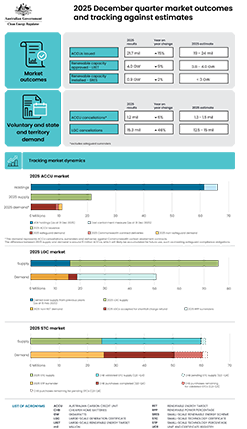
- ACCU supply remains strong, with a record 21.7 million ACCUs issued in 2025 and 2026 supply expected to be between 22 and 26 million ACCUs. As usual, issuance projections are subject to uncertainty. The higher end of our range reflects several potential upsides.
- ACCU holdings, excluding the cost containment measure, grew by 3.9 million during Q4 2025, reaching 60.7 million at the end of 2025.
- At the end of 2025, the cost containment measure held 4.8 million ACCUs. This is expected to grow in 2026 with the Australian Government announcing permanent exit arrangements for fixed delivery Commonwealth carbon abatement contracts in December 2025.
- ACCU issuances continue to outpace ACCU safeguard surrenders and voluntary cancellations on an annual basis. However, with the declining baselines under the reformed Safeguard Mechanism, annual demand will grow and may surpass annual supply later this decade, resulting in a draw-down of accumulated holdings.
- We will publish full results for the 2024-25 safeguard compliance year on 15 April 2026.
Click on the image below to download a full-sized version.
Ways to read the report
Data workbook
The QCMR data workbook – December quarter 2025 contains the data underlying the figures in the report and additional data, including longer time series data.
Updated: 27 February 2026
Changes
Updated:
- Figure 1.3 – Registered Australian Carbon Credit Unit (ACCU) Scheme projects by method type (corrected 2024 annual total to account for revocations)
- Figure 1.6 – Generic Australian carbon credit unit (ACCU) and Safeguard Mechanism credit unit (SMC) volume weighted average spot price (updated with post quarter data)
- Figure 2.2 – Large-scale generation certificate (LGC) reported spot and forward prices (updated with post quarter data)
- Figure 2.3 – Approved large-scale wind and solar capacity in gigawatts (GW) (updated data)
- Figure 3.1 – Cumulative validated battery capacity installed by state and territory (updated with post quarter data)
- Figure 3.2 – Distribution of validated battery installations by size range in kilowatt hours (kWh) for residential systems (updated with post quarter data)
- Figure 3.3 – Distribution of validated battery installations by size range in kilowatt hours (kWh) for non-residential systems (updated with post quarter data)
- Figure 3.4 – Distribution of validated battery installations by installation type (updated with post quarter data)
- Figure 3.7 Small-scale technology certificate (STC) reported spot and clearing house prices (updated with post quarter data)
New:
- Figure 1.4 – Estimated Australian carbon credit unit (ACCU) issuances (in millions) in 2026
- Figure 3.5 – Total small-scale solar PV systems installed with and without a battery
- Figure 4.1 – Estimated emissions reduction from Clean Energy Regulator (CER) schemes
Media release
Read the media release: Carbon abatement schemes deliver emissions reductions comparable to a year of road transport.