
Highlights from the Small-scale Renewable Energy Scheme (SRES) annual inspection report for the 2025–26 financial year.
The SRES inspection program plays a critical role in maintaining the integrity of installations of solar photovoltaic (PV) and solar battery systems around Australia. We administer the SRES inspection program under the Renewable Energy (Electricity) Act 2000 and the Renewable Energy (Electricity) Regulations 2001.
The 2025–26 financial year marks a significant milestone for the inspection program. In addition to the established solar PV inspection program, the solar battery inspections program began on 15 July 2025 after solar batteries became eligible under the SRES on 1 July 2025. By starting inspections shortly after the rollout of the solar battery program, we were able to identify emerging technical, safety and quality issues soon after installation and address them with a targeted response.
Turning inspection results into action
Inspection findings inform our regulatory activities. They provide an evidence base for identifying trends, targeting areas of risk and supporting industry improvement. They help us address recurring issues, strengthen compliance with technical standards and improve installation outcomes.
We have mature systems in place to identify and address non-compliance. Since 1 July 2025, we have contacted over 830 installers about adverse inspection outcomes and their obligations under the SRES.
Installers with adverse inspection outcomes are required to return to site to rectify any issues identified and provide evidence of this to Solar Accreditation Australia, the accreditation body for installers. This supports early intervention and helps installers understand how to meet their obligations. Repeated adverse results or continued non-compliance may lead to further compliance or regulatory action.
Our message to installers is simple – do it once and do it well.
We continue to closely monitor inspection results and will act when we identify unsafe or non-compliant work.
By identifying issues early and holding installers accountable for rectification, we are supporting continuous improvement across the industry and helping ensure solar PV and battery systems are installed safely and to the required standards.
Future priorities
As the solar battery market continues to grow, we will continue to use inspection findings to highlight ongoing compliance risks across both solar PV and battery installations.
For the 2026–27 financial year, we will focus on using inspection findings to drive continuous improvement, provide targeted education to industry and deliver proportionate compliance responses where needed.
Find out how the priorities for the 2026-27 financial year continue to strengthen the integrity of the SRES and support safe, compliant solar PV and battery installations for Australian households and communities.
2025–26 results at a glance
During the 2025–26 inspection period, we completed our highest annual volume of inspections to date.
The SRES inspection program helps us identify emerging risks, monitor compliance and target education and regulatory activities.
We share findings with SAA and state and territory electrical safety regulators to coordinate our response to recurring and emerging issues.
Understanding inspection ratings
Inspectors assess each installation against the relevant inspection checklist and assign one of three ratings.
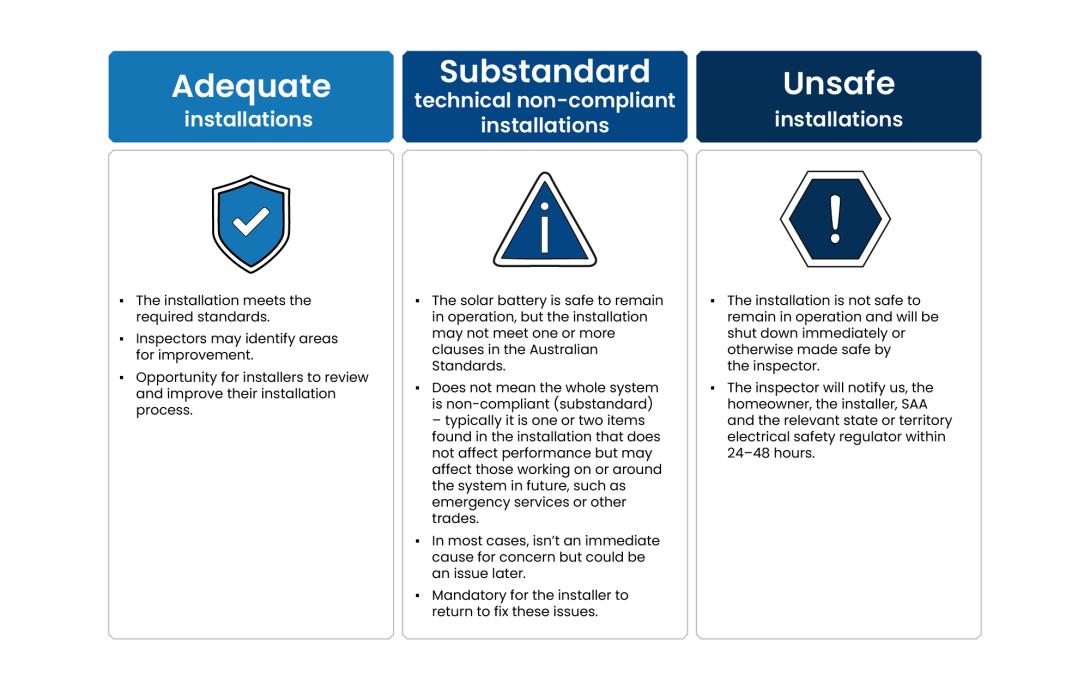
These ratings provide a consistent measure of installation quality. Where an inspection is rated substandard or unsafe due to the installation work, the installer must return to site to fix all identified issues and provide proof to SAA that the issues have been addressed. We may conduct additional monitoring to confirm ongoing compliance and improvements in installation practices.
Solar battery highlights
We use a random sampling method that ensures we get a greater representation of trends for installations around Australia. We also conduct inspections outside of this sample where there is a risk identified through our compliance process.
A total of 3,425 solar battery inspections were completed in the program’s first year, capturing systems installed from 1 July 2025 to 30 April 2026. 3,373 were randomly selected and 52 additional inspections were conducted outside of the random sample.
Of the 3,373 randomly selected inspections:
- 37.86% were adequate
- 61.19% were substandard
- 0.95% were unsafe.
The results for the additional 52 inspections can be found in the 2025–26 SRES inspection report.
Solar battery inspection outcomes by installation month
Description
This graph shows the percentage of inspection ratings by month for solar battery inspections since solar batteries became eligible under the SRES on 1 July 2025.
Adequate inspection outcome
The installation meets the required standards.
Substandard inspection outcome
The solar battery is safe to remain in operation, but the installation may not meet one or more clauses in the Australian standards. This doesn’t mean the whole system is non-compliant. In most cases, it isn’t an immediate cause for concern but could be an issue later.
Unsafe inspection outcome
The installation is not safe to remain in operation and is shut down immediately or otherwise made safe by the inspector.
During the first year of inspections on solar batteries, a total of 32 systems were rated unsafe. This is consistent with the unsafe rate observed for solar PV system inspections during the 2025–26 SRES inspection program, which was less than 1%.
Early results from the inspection program showed the substandard rate peaked at 68.3% in August 2025 for solar battery installations. Substandard results have since dropped to 54.9% for systems installed in April 2026.
We closely monitor inspection result trends to identify emerging risks. We used this intelligence to develop targeted activities to address specific criteria.
Solar battery rectification work required by category
Description
This graph shows the 4 most common rectification categories resulting in a substandard inspection outcome for solar batteries. It covers each quarter of the 2025–26 financial year up to 30 April 2026. The total number of categories may be greater than the total substandard outcomes as a substandard report may have more than one rectification category in an inspection report.
*Data for Q4 is incomplete. The remaining months for the 2025–26 financial year will be captured in the 2026–27 inspection program findings.
Labelling
Missing or incorrect critical warning labels and insufficient identification of backup circuits.
Wiring
Incorrectly configured or missing residual current device when systems have alternate supply.
Overcurrent protection
Insufficient rated circuit protection.
Mechanical protection
Insufficient physical protection for cables and the solar battery.
Based on inspection trends, we strengthened the education and compliance approach through the following activities:
- Increased inspection capacity by engaging additional inspection service providers, enabling ongoing compliance monitoring and maintaining a statistically significant inspection sample amid rapid growth in solar battery installations.
- Introduced mandatory evidence requirements for critical labelling from 1 March 2026 after early inspection results identified labelling as the most common cause of substandard outcomes. This was supported by timestamp and geolocation metadata and artificial intelligence image identification to improve verification activities.
- Implemented more direct installer engagement through our website and targeted communications to installers on emerging issues and risks, and their responsibilities.
- Delivered industry education and guidance by working with SAA to provide regular updates on common non-compliance issues and the delivery of a free solar battery labelling course for accredited installers.
- Took compliance action against installers with repeated poor inspection results. Since 1 July 2025 we have issued:
- 716 initial advisory letters to installers for first time non-compliance
- 121 warning letters to installers with repeated non-compliance
- 1 notice of intent to suspend an installer from the SRES.
This includes systems installed throughout the 2025–26 financial year up and systems installed so far during this financial year.
These activities demonstrate how inspection findings are used not only to identify issues but also to drive measurable improvements and support higher-quality installations.
Solar PV highlights
We use a random sampling method that ensures we get a greater representation of trends for installations around Australia. We also conduct inspections outside of this sample where there is a risk identified through our compliance process.
A total of 3,129 solar PV systems were inspected within the 2025–26 financial year. All inspections were randomly selected from systems installed between 1 July 2024 and 30 April 2026. No additional inspections were conducted outside of the random sample.
Out of the 3,129 randomly selected inspections:
- 75.97% were adequate
- 23.11% were substandard
- 0.93% were unsafe.
Solar PV inspection outcomes by installation year
Description
This graph shows the percentage of inspection ratings by year for solar PV installations for the past 10 years.
*Data for 2026 is incomplete. The remaining months for the 2025–26 financial year will be captured in the 2026–27 inspection program.
Adequate inspection outcome
The installation meets the required standards.
Substandard inspection outcome
The solar PV system is safe to remain in operation, but the installation may not meet one or more clauses in the Australian standards. This doesn’t mean the whole system is non-compliant. In most cases, it isn’t an immediate cause for concern but could be an issue later.
Unsafe inspection outcome
The installation is not safe to remain in operation and is shut down immediately or otherwise made safe by the inspector.
A total of 29 installations were unsafe, representing less than 1% of systems inspected during the 2025–26 financial year.
Inspection results for solar PV systems installed up to 30 April 2026 indicate a lower proportion of adequate outcomes. The current sample size is not yet representative of the 2026 installations. Further inspections during 2026–27 will enable a more accurate assessment of installation quality for systems installed in 2026.
Solar PV rectification work required by category
Description
This graph shows the most common rectification categories resulting in a substandard inspection outcome for solar PV systems. It is broken down by year from 2023 to 2026 with inspections conducted up to 30 April 2026.
*Data for 2026 is incomplete. The remaining months for the 2025–26 financial year will be captured in the 2026–27 inspection program.
The total numbers of causes for substandard installations are not equal to substandard totals provided, as more than one non-compliance checklist item may be selected in an inspection to make a single system substandard.
Cable/conduit
Where cables may not meet the relevant size, output or mechanical protection requirements under the relevant standards. This includes where wiring is not sufficiently protected, cables are incorrectly fixed onto the system or where conduits are not correctly routed or enclosing the cables.
Earthing
Improper bonding or earthing of solar panel frames and associated equipment.
DC connectors
Where solar connectors are not compatible, secure and/or correctly installed.
Mounting structure
Where the railing, clamps and other frameworks are not sufficiently installed.
System design and configuration
Where the system layout, sizing and equipment configurations are not compliant with the relevant Australian standards.
Priorities for 2026–27 financial year
In the 2026–27 financial year, we will focus on:
- working closely with SAA and state and territory regulators to provide ongoing education and guidance to support compliant solar PV and solar battery installations under the scheme
- delivering proportionate regulatory responses for installers who show a pattern of non-compliance
- monitoring inspection results and findings to ensure accurate and independent assessments of systems under the inspections program
- providing more timely inspection results by reducing the time between when the installation is completed and the inspection is conducted
- improving installer compliance through ongoing monitoring, follow-up inspections and compliance activities.
By focusing on these priorities, we will continue to strengthen the integrity of the scheme.