Under the Renewable Energy Target (RET), we're responsible for conducting inspections on small-scale renewable energy systems.
Our inspections ensure select systems under the Small-scale Renewable Energy Scheme (SRES):
- meet installation requirements
- are eligible for small-scale technology certificates (STCs).
We work closely with state and territory electrical safety regulators, the installer accreditation scheme operator and the broader industry to share inspection findings and drive continuous improvement.
Our inspections program does not replace electrical safety laws, or the inspection and compliance programs administered by relevant state and territory authorities. Instead, it complements these laws to inform states and territories in performing their regulatory functions.
Benefits of inspections
Inspection findings help to identify non-compliance and safety issues early. As an important part of the industry feedback cycle, this data is used to inform industry education, improve compliance for installations and support scheme integrity.
Through inspections, we confirm:
- compliance with certificate creations
- installations meet the relevant Australian standards, jurisdictional standards and industry requirements.
We share inspection data, including insights on key learnings and risks, with:
- relevant state and territory electrical safety regulators
- Solar Accreditation Australia (SAA) – the SRES accreditation body.
We also analyse inspection data to investigate significant trends and develop long-term plans based on installer behaviour. This helps inform education priorities for state and territory regulators that are responsible for electrical safety.
Inspection results
We closely monitor inspection results to identify key learnings and risks. We publish results on a regular basis and share with relevant Commonwealth, state and territory regulators.
There are 3 possible inspections outcomes.
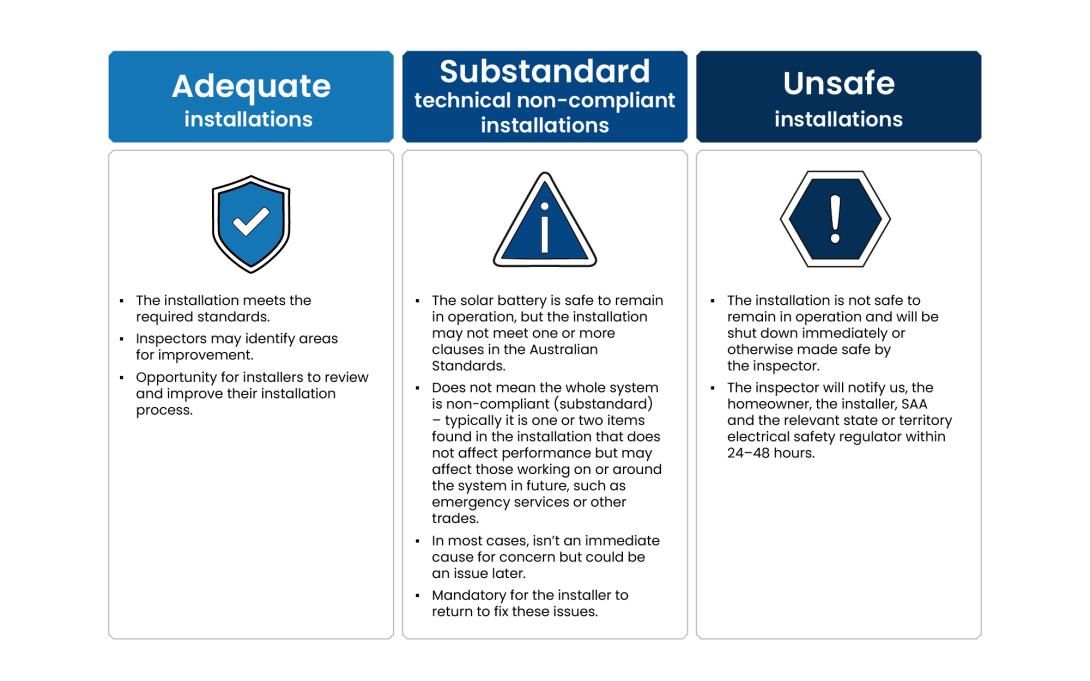
Solar battery inspections results
The solar battery inspections program commenced on 15 July 2025, soon after solar batteries became eligible under the SRES on 1 July 2025.
The inspections program plays a vital role in allowing us to drive continuous improvement through quickly identifying areas of non-compliance. We’ll publish regular updates on inspection results for solar batteries.
Solar PV inspections results
We publish an annual inspections update for solar PV inspections identifying:
- the number of inspections conducted by state and territory
- the number of system installations deemed adequate, substandard or unsafe
- how the latest inspection results compare with previous years.
The Australian National Audit Office reviewed the RET administration in 2018.
We prepared an SRES residual systemic safety risks report in response to the review. Our report includes:
- the finding of the common cause of unsafe systems
- recommendations to relevant government bodies to help improve system safety.
Inspection process
We are required to inspect a statistically significant sample of installations each year and provide the results to those with the power to enforce standards – state and territory electrical safety regulators.
We may also conduct inspections when it's appropriate or necessary to do so.
If your solar PV or battery system is selected for inspection, you will be contacted by one of our inspection companies to arrange an appointment time.
Participation is voluntary and the inspection can only go ahead with your written consent. There is no cost to participate. Inspections provide you with assurance that your system has been installed correctly. They also play a vital role in supporting the integrity of the SRES.
Inspections can’t be requested. If you have any concerns about your system, contact your retailer or installer.
Conducting an inspection
The SRES inspections program uses a checklist developed with industry experts to determine whether an installation meets the required standards.
The inspection companies currently conducting inspections are:
- Australian Solar Energy Society Limited T/A Smart Energy Council
- Ecologiq Pty Ltd
- Global Sustainable Energy Solutions Pty Ltd
- IT Power (Australia) Pty Ltd
- Kerfoot PTY LTD
- Master Electricians Australia
- Springcity Pty Ltd
- TechSafe Australia Pty Ltd.
Inspection companies are selected through a public tender process. For more information visit AusTender.
During inspections, the appointed inspectors must:
- get consent from the homeowner or occupier to carry out an inspection of their system
- explain why they are inspecting the system to the homeowner or occupier
- leave the premises if requested by the owner or occupier
- show their identity card before inspecting
- follow all requirements and conditions of their electrical licence
- comply with relevant state or territory law.
As part of the inspection process, inspectors may:
- inspect, measure or test the system
- take photos or record audio or video of the inspection
- access the rooftop cavity of the property to carry out the inspection
- ask questions about the design, installation and certification creation.
After the inspection
The inspector will prepare a report for us detailing the outcome of the inspection. The inspection report will identify any checklist items that aren’t fully compliant:
- Recommendation for improvement checklist items – these are items that can be improved but are not required to be rectified. Installers are encouraged to change their processes to address this for future installations.
- Rectification required checklist items – these are items that must be rectified by the installer. You should contact your installer to arrange for these items to be fixed.
Find out about the steps the installer must take to rectify issues.
Roles and responsibilities
The inspection program complements electrical safety laws by using a cross-agency approach to communicate and address areas of concern.
The following parties hold roles and responsibilities in the inspections process for small-scale renewable energy systems.
We are responsible for:
- ensuring yearly inspections cover a statistically significant sample across all small-scale renewable energy systems
- appointing inspectors
- providing final inspection reports to the:
- system owner or occupier
- agent, system designer and installer
- installer and designer accreditation scheme operator
- relevant electrical safety authorities
- taking appropriate compliance and enforcement action for improperly created certificates.
Appointed inspectors are individuals contracted to an inspection company who are independent of the system designer or installer. This means they hold no conflict of interest with the installed system.
Appointed inspector’s responsibilities include:
- checking installations followed relevant laws and standards
- receiving training to maintain accreditation from the accreditation scheme operator
- holding an unrestricted electrical licence in the relevant state or territory
- having experience and knowledge of relevant laws and standards
- maintaining a good reputation within the industry and acting with honesty and integrity.
Following an inspection, inspectors must:
- report unsafe installations to relevant electrical safety authorities, distribution network service providers, the owner or occupier and us
- prepare written inspection report
- recommend steps to rectify identified issues, prioritising safety and operational problems
- provide final inspection reports to us.
Responsibilities include:
- administrating or enforcing electrical safety standards
- administrating or enforcing building design and construction safety.
Responsibilities include:
- managing solar installer and designer accreditation
- conducting training and providing guidance to the industry to address common installation defects and emerging risks
- enforcing rectification work by accredited installers
- managing installer or designer compliance matters and reporting to us.