
To use wood waste as an eligible energy source for the Renewable Electricity Guarantee of Origin (REGO) or the Renewable Energy Target (RET), you need to understand the eligibility requirements, obligations and documentation that applies.
Facilities and power stations should follow this guidance when registering their systems and creating certificates.
Requirements for using wood waste
Participants must:
- use eligible wood waste and know the different types
- carry out due diligence checks before processing
- measure energy accurately and consistently
- maintain evidence and documentation that:
- supports registration and certificate eligibility
- tracks the material through the supply chain.
Eligibility
Eligible wood waste
There are 4 different types of eligible wood waste under the REGO and RET.
Type A
Non-native biomass harvested for the purpose of weed control, with appropriate eradication or weed control approvals from local and state government authorities.
Type B
Manufactured wood products such as:
- packing cases or pallets
- recycled timber
- engineered wood products (including those manufactured by binding)
- wood strands, wood particles, wood fibres or wood veneers with adhesives to form a composite.
By-products from manufacturing processes such as furniture, timber offcuts and saw residue such as shavings or chips.
Type C
Wood waste from building construction and demolition which includes:
- timber offcuts
- sawdust
- wood rejections
- wood chips and shavings.
Type D
Sawmill residue.
Ineligible wood waste
- Fossil fuels and any by-products, materials or waste products derived from fossil fuels
- Biomass from a native forest regardless of whether it would otherwise fit into an eligible category (see section 34 of the Future Made in Australia (Guarantee of Origin) Rules 2025 for a definition of native forest)
- Land or broadacre clearing of any type (some waste from land clearing may be eligible as biomass-based components of municipal solid waste, depending on the purpose of the land clearing)
- Waste that does not meet sustainable wood harvesting standards, forest management principles or code of conduct
- Fruit or nut tree coppicing and thinnings (some waste from coppicing and thinnings may be eligible as biomass-based components of municipal solid waste)
- Wood from agricultural tree crops or orchards that have been removed to replant a new crop for the purpose of increasing fruit or nut yield production (some waste from agriculture may be eligible as biomass-based components of municipal solid waste, noting that land clearing for agriculture is excluded)
- Sugar cane waste (this waste may be eligible as bagasse)
- Biomass derived from plantations (this may be eligible as energy crops)
Due diligence requirements
Facilities using sawmill residue or wood waste from the processing of raw logs must understand and meet their due diligence requirements under the:
Read the Australian Department of Agriculture, Fisheries and Forestry guidelines to help facilities meet their due diligence requirements.
If the same company or organisation processed and harvested the raw log, timber products are exempt from the due diligence obligations.
Measuring wood waste
All facilities must comply with either the:
- Future Made in Australia (Guarantee of Origin) Measurement Standard 2025 (for REGO)
- metering requirements (for RET).
These set out the technical requirements for electrical meters that must be installed at the facility to determine how much electricity is being generated.
With every certificate claim, facilities must provide us with:
- meter data from compliant meters
- the mass (in tonnes or otherwise) of each type of energy source burnt
- the calorific value of each type of energy source burnt.
We use these values to estimate how much electricity should be generated from eligible biomass. We check this against the meter data to verify claims.
If your facility is burning both eligible and ineligible energy sources in the same burner, we use the values to subtract the ineligible energy sources from the electricity generated.
Evidence and documentation
Participants using wood waste must prove they meet eligibility and scheme requirements when registering their facility or creating certificates.
This includes keeping accurate records and providing documentation to support certificate claims.
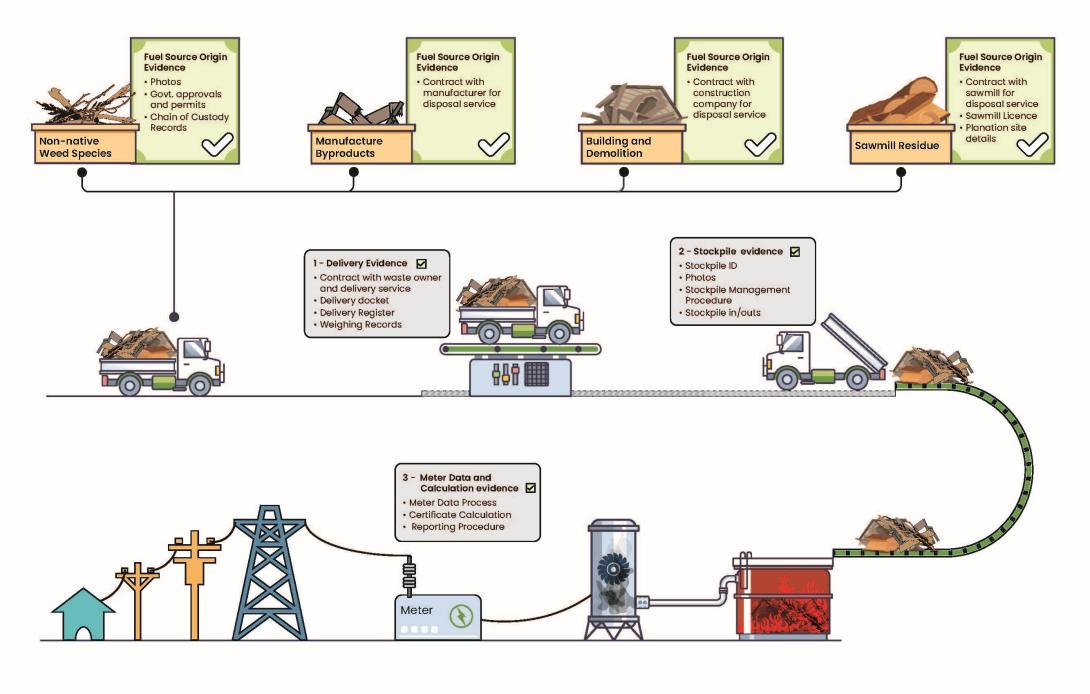
Chain of custody and audit trail
Facilities must maintain a chain of custody. This is a traceable set of records that shows how wood waste was collected, stored, analysed and processed. All records must be kept for 7 years.
The chain of custody must:
- identify who handled the wood waste at each stage
- state the purpose of movement
- include the date and time of collection and delivery
- include all relevant approval documents.
These records form your audit trail.
Responsibility for documentation
The facility’s eligible registered person (for REGO) or nominated person (for RET) is responsible for:
- making sure sufficient evidence is provided to us
- declaring the documents are complete and accurate.
However, each person in the supply chain plays a role in collecting and maintaining documentation.
Documentation requirements by role
View the documentation requirements for different participants in the supply chain and when facilities must submit them.
For wood waste type A:
| Requirement | Documents required | When facilities must submit it |
|---|---|---|
| Prove biomass comes from an approved harvesting operation. |
| With the first certificate claim that uses wood waste sourced from a new harvesting operation. |
| Prove biomass is produced from a non-native environmental weed species and harvested for the control or eradication of the species. |
| With the first certificate claim that uses wood waste sourced from a new harvesting operation. |
For wood waste types B, C and D:
| Requirement | Documents required | When facilities must submit it |
|---|---|---|
| Confirm the biomass fits the wood waste category. |
| With every certificate claim that includes wood waste. |
| Prove the processer has complied with illegal logging legislation. |
| With the first certificate claim that uses wood waste from a supplier that hasn’t been used before. |
| Requirement | Documents required | When facilities must submit it |
|---|---|---|
| Prove biomass comes from an eligible source. |
| With every certificate claim that includes wood waste. |
| Requirement | Documents required | When facilities must submit it |
|---|---|---|
| Prove biomass comes from an eligible source. |
| With every certificate claim that includes wood waste. |
Best practice
- Embed quality management systems (QMS) and industry best practice principles into your internal governance documentation (e.g. standard operating procedures and work instructions)
- Conduct and record regular internal audits to ensure your governance arrangements and QMS account for any changes in people, processes, IT systems and suppliers
- Complete the generation data template in Online Services accurately for every REGO certificate claim
- Complete the wood waste eligibility assessment sheet for every large-scale generation certificate claim
- Read and follow all published government guidance on wood waste processing
Following best practice can help you reduce the risk of non-compliance.