This update provides an overview of the Small-scale Renewable Energy Scheme (SRES) inspections program for solar batteries installed from 1 July 2025.
The inspections program does not replace electrical safety regulations, or the inspection and compliance programs administered by relevant state and territory authorities. Instead, it complements these laws by using a cross-agency approach to communicate and address areas of concern.
We randomly select installations for inspection from the small-scale technology certificate (STC) applications we receive. We also conduct additional inspections on installations by installers who are found to be non-compliant.
We’ll inspect a statistically significant sample of all solar battery systems that claim STCs. We’ll closely monitor inspection results to identify potential safety issues early and work closely with industry to improve compliance. This includes working with state and territory electrical safety regulators who have the power to enforce standards.
This page will be updated regularly to reflect the latest results.
Overview and safety priorities
As a new inspections program under the SRES, our early results are tracking similar to other state and territory battery inspection programs. It’s too early to draw strong conclusions about the rate of technical compliance under the scheme.
As of 30 June 2026, 478,176 solar batteries have been installed across Australia since 1 July 2025, equating to 13.58 GWh of installed storage capacity. These solar batteries, distributed across households and businesses, represents a rapid acceleration of progress towards Australia’s target of 82% renewables by 2030.
Safety is a priority
By certifying the installation as compliant, installers are confirming that the installation is safe and eligible under the SRES. Where our inspections find unsafe and non-compliant systems, we won’t hesitate to use our compliance powers. This can result in installers being removed from the SRES. Our established systems that have supported over 4.2 million rooftop solar systems are now working to successfully support the growing number of solar battery installations. This includes identifying areas of non-compliance quickly and allowing us to drive continuous improvement through:
- ongoing and targeted education for installers in collaboration with Solar Accreditation Australia based on the latest inspection findings
- working with state and territory electrical safety regulators to update and refine the inspections program to better reflect emerging risks
- taking appropriate enforcement action against installers where necessary, including to declare installers ineligible to participate in the SRES if installations repeatedly fail to meet requirements.
Installed products must be on the Clean Energy Council’s approved product lists and meet relevant standards to be eligible under the SRES. The ongoing safety of approved products is the responsibility of the CEC, state and territory regulators and, where required, the Australian Competition and Consumer Commission (ACCC) who manages a national recall system for electrical products.
As of 17 December 2025, one eligible product under the SRES has been recalled. The Australian Competition and Consumer Commission (ACCC) issued a voluntary electrical safety recall for Sigenergy single phase 8/10/12 kW energy controllers on 19 November 2025. Sigenergy is committed to rectifying this issue and is working with the ACCC, state and territory electrical safety regulators and installers to ensure the ongoing safety of the affected product.
Inspection results
As of 30 June 2026, we have conducted 3,425 solar battery inspections on installations that have received STCs. A breakdown of the inspections across the states and territories is as follows:
- 926 inspections in NSW
- 718 inspections in QLD
- 690 inspections in VIC
- 467 inspections in SA
- 392 inspections in WA
- 154 inspections in ACT
- 44 inspections in TAS
- 34 inspections in NT.
Inspections program checklist items
The inspections program uses a checklist developed with industry experts. The checklist items reflect regulations, standards and industry requirements. The checklist has over 90 items* that review compliance and safety.
In total, our inspectors have reported on over 285,889 checklist items across the 3,425 inspections.
Of these:
- 1.28% of checklist items have required rectification
- 5.23% of checklist items have been identified as areas for improvement
- 93.49% of checklist items have been found compliant.
* Not all checklist items apply to every installation. Relevant checklist items depend on the installation and battery type. Some installations may have more than one item marked.
How to use the graphs on this page
The graphs on this page are interactive. To see more detailed information for these graphs:
- hover your cursor over the areas and data points to see more information in a pop-up
- click the legend labels below the graphs to change what data is displayed in the graph
- click the menu icon in the top right corner of each graph for more options, including downloading source data or images of the graph as it is displayed on the screen.
Checklist items by ratings for all inspections
Checklist criteria results by category
Description
This graph shows a breakdown of checklist items per category.
Numbers less than 1% may not be visible.
Small print
Compliant checklist items comply with installation requirements.
Recommendation for improvement checklist items can be improved but are not required to be rectified – installers are encouraged to change their processes to address this for future installations.
Substandard (technical non-compliance) – rectification required checklist items must be rectified by the installer – system owners should contact their installer to arrange for these items to be fixed.
Unsafe – rectification required checklist items must be rectified before the system can be switched back on.
Installation ratings
Upon completion of an inspection, installations are given an overall assessment as either adequate, substandard (technical non-compliance) or unsafe.
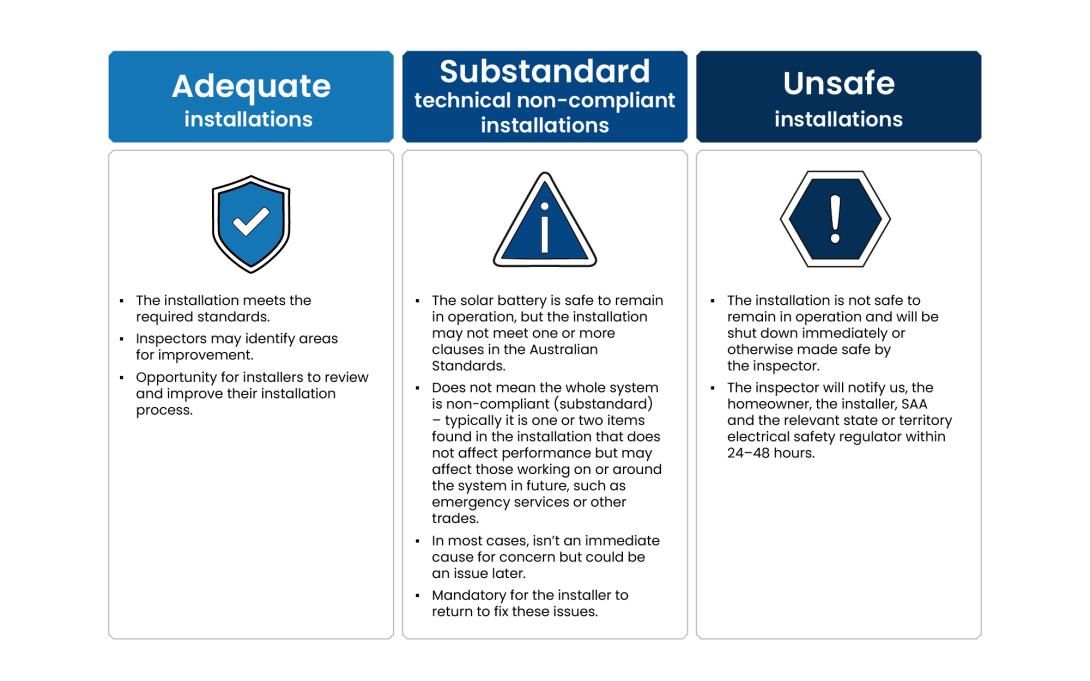
Based on all inspections, the ratings are:
- 0.76% have been found unsafe.
- 62.28% have been found substandard but were safe to remain in operation.
- 36.95% have been found adequate and safe.
No installations had issues with the solar battery itself. Instead, all issues were due to non-compliant installation practices and substandard workmanship.
The issues leading to the unsafe installations included:
- Wiring
- Loose connections in pre-assembled battery systems and associated wiring with signs of heat
- Pre-assembled battery system electrical work not in line with Australian standards, constituting a safety hazard which poses imminent risk.
- Protections
- Neutral continuity was not maintained for all circuits operating on an alternative supply.
The most common reason for installations to have technical non-compliance was due to labelling issues.
Checklist criteria requiring rectification
Description
This graph shows checklist categories requiring rectification by quarter.
Small print
Data for Q3 and Q4 is not yet complete and may change once finalised. The finalised data will be published in future updates.
Results for future quarters will be added once available.
The most common labelling issues for substandard – technical non-compliant installations include:
Incorrect or missing warning label
A compliant warning label must be installed at the main switchboard and at any intermediate distribution boards where a multimode inverter with an alternative supply is connected. The label must include the shutdown procedure for safe isolation and the statement ‘Neutral and earth circuits may be live under fault conditions’
Incorrect or missing warning labels are a common non-compliance observed during inspections. A common misunderstanding is what constitutes an intermediate distribution board. Where a battery is connected via a gateway that contains a protective device (for example, a circuit breaker) this is considered a distribution board, and the required warning label must be installed.
Incorrect labelling of backed-up circuits
Battery systems may include a back-up supply. This can leave some or all circuits energised, even when the main switch is off. Some systems may also re energise after a short delay.
Clear labelling is required to reduce the risk of electric shock. This helps electricians and other qualified professionals work safely. Incorrect or missing labelling is a common non-compliance.
Backed-up circuits must be grouped together at the switchboard. This makes it easier to identify any sources of back-up power.
Incorrect labelling for emergency services
An energy storage (ES) identification label must be installed on or next to the meter box and switchboard. The label must be clearly visible when approaching the site.
The ES label alerts emergency services that a battery system is installed. This supports a safe emergency response. Missing or incorrectly placed ES labels are a common non-compliance.
The label must:
- be a green reflective sign marked ‘ES’, and
- be installed where it can be easily seen.
The most common wiring issues for substandard – technical non-compliant installations are:
Incorrectly configured or missing residual current device (RCD)
RCDs are designed to protect against electric shock and fire by cutting off power when an electrical fault occurs. RCDs must be correctly configured and installed wherever alternate supply circuits exist.
Insufficient mechanical and fire protection
Mechanical protection is installed and fire protection requirements are met to protect the battery system from mechanical damage by impact or fire spread.
Inadequate overcurrent protection for inverter circuits
Overcurrent protection is installed and appropriately designed to protect inverter output cabling and connected circuits if electrical conditions change or a fault occurs, including situations where current may be supplied from more than one source. Protection is applied by considering the circuit as a whole, including where higher currents could originate and how the circuit would be safely interrupted under fault conditions.
System inspection findings by state
Continuous improvement
Safety has been a key consideration throughout the design and implementation of the Cheaper Home Batteries Program and remains a priority.
To strengthen installation quality and uphold scheme integrity we have:
- commenced compliance action against installers with repeated poor inspection results – includes issuing compliance advisory warning letters and notices and progressing further formal compliance actions such as suspending installers from participating in the scheme
- implemented new photo requirements from 1 March 2026 to improve installer compliance with labelling requirements – the most common criteria leading to substandard inspection outcomes
- in consultation with SAA, worked to improve training and develop additional mandatory training modules and other education materials based on non-compliance trends
- published a solar battery inspection checklist to help installers understand what is assessed during an inspection
- continue to hold regular briefings to share inspection data with state and territory electrical, safety and consumer regulators – those with the responsibility to enforce Australian standards
- continue to hold regular meetings with industry representatives to discuss program observations and learnings.
We have expanded our inspection program to match the rapid growth of solar battery installations across Australia. Impacts from new measures are not always immediately reflected in inspection results due to inspection and installation cycles. We closely monitor our controls and inspection results so we can adjust our areas of focus.
Our inspection program doesn’t replace electrical safety regulations, or the inspection and compliance programs administered by relevant state and territory authorities. Instead, it complements these programs by serving as a tool to help us identify emerging trends.
We’ll continue to work with state and territory authorities, SAA and industry as we continue to improve compliance and electrical safety, make this program a success and work to our national renewables goal.